Bayesian in Python
Last updated 2024-09-26
Bayesian Theorem
The Bayesian Theorem is the foundation of Bayesian analysis. It allows us to update the probability of a hypothesis (event A) given new evidence (event B). In this article, three key forms of the theorem are presented:
Theorem 1
This is the basic formula for conditional probability. It tells us how to find the probability of A happening given that B has happened by using the joint probability of A and B.
\[P(A | B) = \frac{P(A \cap B)}{P(B)}\]
Theorem 2 (Bayes’ Theorem)
This is Bayes’ Theorem, which is essential in Bayesian inference. It shows how the P(A) (the prior probability) can be updated given new evidence B. The term P(B∣A) is the likelihood, which describes how likely it is to observe B given that A is true. The denominator P(B) normalizes the result and ensures that the updated probability (posterior) is valid.
\[P(A | B) = \frac{P(B | A) \times P(A)}{P(B)}\]
Theorem 3 (Law of Total Probability)
This theorem helps in computing the overall probability of A by considering all possible events \(B_i\) that could lead to A. Each \(B_i\) represents a different scenario, and their probabilities are weighted by how likely they are.
\[P(A) = \sum_i P(A | B_i) \times P(B_i)\]
Cookies Problem
The Cookies Problem is a well-known Bayesian puzzle designed to show how Bayes’ Theorem works in practice. In this problem, we have two bowls with different proportions of chocolate and vanilla cookies. Bowl 1 contains 30 chocolate cookies and 10 vanilla cookies, while Bowl 2 contains 20 chocolate cookies and 20 vanilla cookies.
The goal is to determine the probability that a chocolate cookie came from Bowl 1, given that a chocolate cookie was selected. \(P(\text{bowl}_1 | \text{cookies}_c)\)
Solution: By Diagram
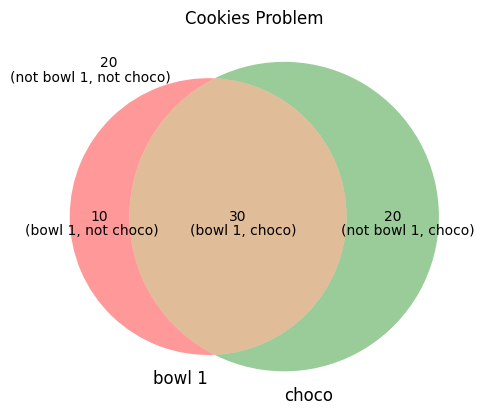
We start with a visual representation of the problem using a Venn diagram. The diagram illustrates the relationship between the two bowls and the distribution of chocolate and vanilla cookies.
The probability that a chocolate cookie was chosen from Bowl 1 can be simply calculated by:
\[P(\text{bowl}_1 | \text{cookies}_c) = \frac{30}{30 + 20} = \frac{3}{5}\]
This quick method gives a straightforward answer, but it assumes that we already know some of the probabilities, such as the total number of chocolate cookies in both bowls.
Solution: By Formula
To arrive at the same answer using Bayes’ Theorem:
\[P(\text{bowl}_1 | \text{cookies}_c) = \frac{P(\text{cookies}_c | \text{bowl}_1) \times P(\text{bowl}_1)}{P(\text{cookies}_c)}\]
We calculate the likelihood that a chocolate cookie came from Bowl 1, the prior probability that the cookie came from Bowl 1, and the marginal probability of selecting a chocolate cookie from either bowl as a weighted sum of the probabilities of choosing a chocolate cookie from each bowl.
Thus:
\[P(\text{bowl}_1 | \text{cookies}_c) = \frac{\frac{30}{30 + 10} \times \frac{1}{2}}{\frac{30}{30 + 10} \times \frac{1}{2} + \frac{20}{20 + 20} \times \frac{1}{2}} = \frac{3}{5}\]
This more rigorous approach shows how Bayes’ Theorem calculates posterior probabilities using evidence.
from fractions import Fraction as frac

p_c_b1: frac = frac(30,(30+10))
p_b1: frac = frac(1, 2)
p_c: frac = frac((30+20), (30+10+20+20))

p_b1_c: frac = p_c_b1 * p_b1 / p_c
print(p_b1_c)
Fraction(3, 5)
Solution: By Bayes Table
In this approach, we construct a Bayes table, which is another useful method to solve Bayesian problems systematically.
- First list the priors: the initial probability of each bowl.
- Then, add the likelihoods: the probability of drawing a chocolate cookie from each bowl.
- The numerator for each row is the product of the prior and the likelihood.
- Normalize by dividing by the sum of the numerators, which gives the posterior probabilities.
import pandas as pd
from fractions import Fraction as frac

data: dict = {
  "bowl": ["bowl 1", "bowl 2"],
  "prior": [frac(1, 2), frac(1, 2)],
  "likelihood": [frac(30, 40), frac(20, 40)]
}

bayes_table: pd.DataFrame = pd.DataFrame(data)

bayes_table["numerator"] = bayes_table["prior"] * bayes_table["likelihood"]
normaliser: float = bayes_table["numerator"].sum()
bayes_table["posterior"] = bayes_table["numerator"] / normaliser

print(bayes_table)
bowl prior likelihood numerator posterior 0 bowl 1 1/2 3/4 3/8 3/5 1 bowl 2 1/2 1/2 1/4 2/5
The table shows the posterior probabilities as \(\frac{3}{5}\) for Bowl 1 and \(\frac{2}{5}\) for Bowl 2, confirming the previous calculations.
Solution: By empiricaldist.Pmf
The empiricaldist Python library is another method that we could use. Here, we create a prior distribution (which assumes both bowls are equally likely) and multiply it by the likelihood of selecting a chocolate cookie from each bowl. After normalizing the results, we get the same posterior probabilities: 60% (0.6) for Bowl 1 and 40% (0.4) for Bowl 2.
import numpy as np
from empiricaldist import Pmf

prior: Pmf = Pmf.from_seq(["bowl 1", "bowl 2"])
likelihood_chocolate: np.ndarray = np.array([30/40, 20/40])
posterior: Pmf = prior * likelihood_chocolate
posterior.normalize()
print(posterior)
bowl 1 0.6 bowl 2 0.4
This approach is useful for practical coding implementations where distributions and normalizing operations are needed.
Solution: By PyMC (Approximation)
We also see how to use PyMC, a probabilistic programming framework, to solve the problem. This method uses sampling to estimate the posterior probability through approximation.
- Define a prior distribution: there’s a 50% chance that the cookie came from Bowl 1.
- Set up the conditional likelihood based on which bowl the chocolate cookie might have come from.
- Using Monte Carlo sampling, simulate the posterior probability distribution.
import arviz as az
import pymc as pm

prob_bowl_1: float = 1 / 2
choco_likeli_bowl_1: float = 30 / 40
choco_likeli_bowl_2: float = 20 / 40

with pm.Model() as model_choco:
  # prior
  bowl_1 = pm.Bernoulli("bowl_1", p=prob_bowl_1)

  # conditional likelihood
  choco_likelihood = pm.Deterministic(
      "choco_likelihood",
      pm.math.switch(bowl_1, choco_likeli_bowl_1, choco_likeli_bowl_2)
  )

  # observation
  pm.Bernoulli("obs", p=choco_likelihood, observed=1)

  # inference
  ichoco = pm.sample()

print(az.summary(ichoco, round_to=3, kind="stats"))
| mean | sd | hdi_3% | hdi_97% | |
|---|---|---|---|---|
| bowl_1 | 0.601 | 0.490 | 0.00 | 1.00 |
| choco_likelihood | 0.650 | 0.122 | 0.50 | 0.75 |
The results give a posterior of around 0.601 for Bowl 1, which closely matches the analytical solution.
The switch method used in this approach is an efficient and straightforward solution for problems with a limited number of categories, such as the two-bowl scenario in this case. It excels in handling such problems directly and is commonly used for simpler models. However, if the problem were extended to include more than two bowls or more complex conditions, the switch method could become less ideal, as managing multiple nested conditions might reduce readability and scalability.
Solution: By PyMC (Alternate Solution)
The alternate PyMC solution introduces a cleaner and more scalable approach, particularly useful when the problem is extended to more than two bowls. This solution leverages PyMC’s Categorical distribution to represent multiple possible bowls, making the code more readable and easier to extend to problems with more than two categories.
- Define a categorical prior distribution: Instead of a binary outcome (Bowl 1 or Bowl 2), we use a categorical distribution, allowing for more bowls in the future.
- Set up the likelihood: The likelihood for each bowl is calculated using logical conditions that scale easily with more bowls.
- Inference: Similar to the first PyMC solution, we use Monte Carlo sampling to estimate the posterior probabilities.
import numpy as np
import pymc as pm


# bowl[0] == bowl 1, bowl[1] == bowl 2
prior_bowl: list = [1/2, 1/2]
choco_likeli_by_bowl: list = [30/40, 20/40]


with pm.Model() as alternate_model:
  # prior
  bowl = pm.Categorical("bowl", p=prior_bowl)

  # likelihood
  choco_likelihood = pm.Deterministic(
    "choco_likelihood",
    pm.math.eq(bowl, 0) * choco_likeli_by_bowl[0] +
    pm.math.eq(bowl, 1) * choco_likeli_by_bowl[1]
  )

  # observation
  pm.Bernoulli("obs", p=choco_likelihood, observed=1)

  # inference
  ialternate = pm.sample()


prob_bowl_if_bowl = ialternate.posterior.bowl.values
print(np.mean(prob_bowl_if_bowl == 0), np.mean(prob_bowl_if_bowl == 1))
0.598 0.402
This solution provides almost the same result as the first PyMC solution, but it is structured in a way that can handle more than two bowls without becoming overly complicated. Instead of using a nested switch statement, this approach uses PyMC’s Categorical distribution to manage multiple categories cleanly.
In the first PyMC solution, az.summary was used to summarize the posterior distribution, which works well because it presents numerical results for continuous variables like the posterior probability of each bowl. However, in the second PyMC solution, the problem involves categorical variables (representing which bowl the cookie came from), and taking the mean of such categories could be misleading.
Therefore, instead of using az.summary, which is suitable for continuous variables, the alternate PyMC solution uses np.mean by directly specifying the value of the bowl. This method accurately reflects the proportion of times the model inferred each bowl, providing a clearer and more meaningful interpretation of the categorical results.
The PyMC approach is beneficial when exact formulas become difficult to apply or when working with more complex models. It allows for Bayesian inference through simulations, offering an approximate but powerful solution.
Summary of Methods
- Diagram: A quick visual approach, useful for small problems.
- Formula: The core application of Bayes’ Theorem.
- Table: A systematic way to organize and solve Bayesian problems step-by-step.
empiricaldist: A practical implementation in Python for handling Bayesian distributions and probabilities.PyMC: A probabilistic programming approach that handles more complex models with sampling.
Conclusion
This article provides a clear, structured approach to understanding Bayesian inference through both mathematical theory and practical examples. The different methods of solving the Cookies Problem show the flexibility and applicability of Bayesian analysis. By demonstrating the same problem through multiple methods, including traditional formulas and modern probabilistic programming tools, we effectively illustrate how Bayesian thinking can be applied to a variety of problems, making it accessible for a wide audience, especially those working in Python and data analysis.
References
- Bayesian Data Analysis 3rd Ed.
- Martin Osvaldo A, Bayesian Analysis with Python. Packt Publishing. 2024. ISBN 978-1-80512-716-1
- Think Bayes 2